

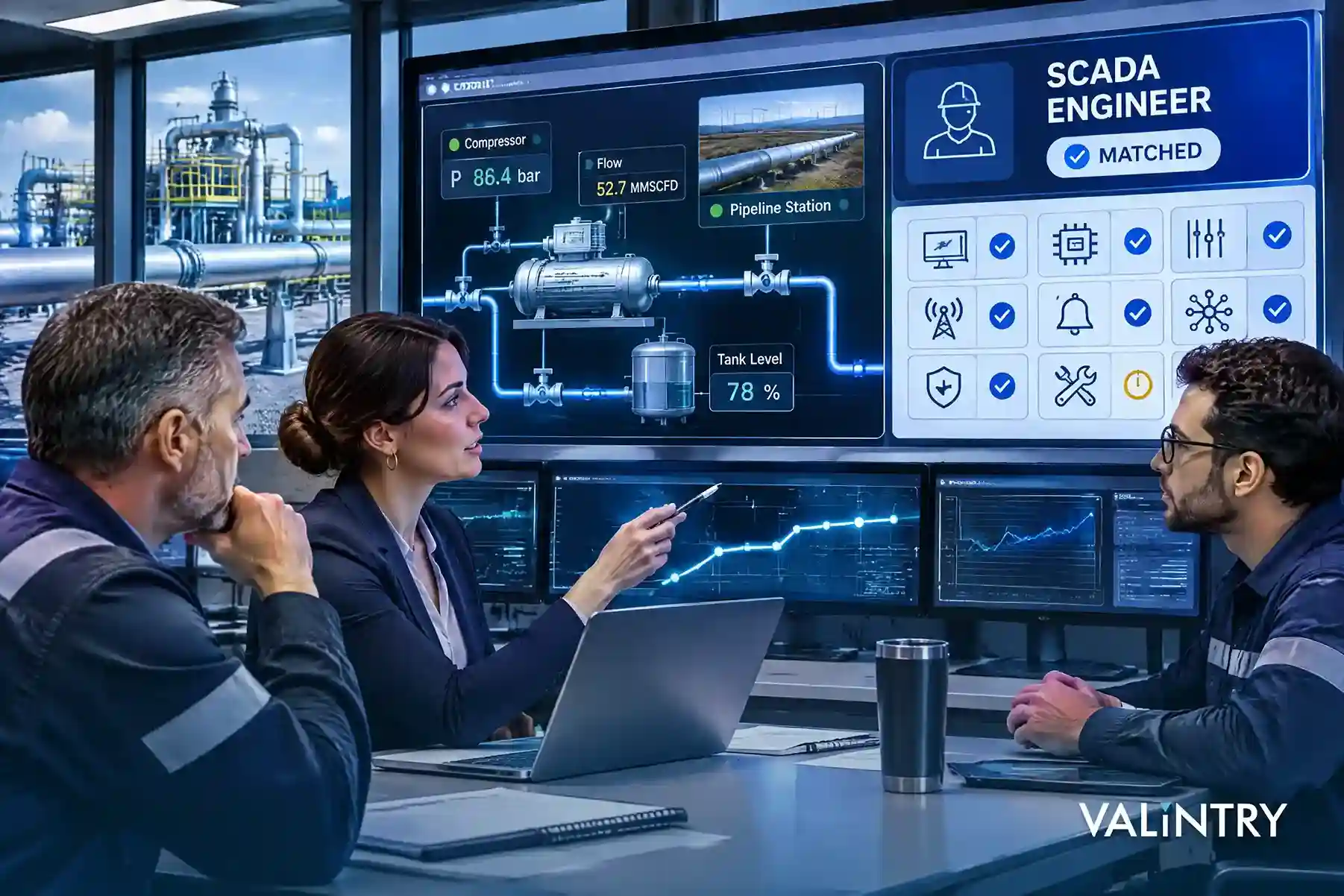
Your control room depends on a system most people in the company never see. When the engineer who built and maintains it gives notice, the risk becomes visible fast: alarm changes stall, upgrades wait and every cyber audit question lands on someone who's already stretched.
That's the situation many pipeline operators and renewable energy companies face right now. The role sits between operations, IT and engineering, so it rarely gets the attention of a core engineering seat until it's empty.
This post explains why SCADA engineering roles are hard to fill in pipeline and solar control rooms, how the two environments differ and what to screen for. It also covers when contract SCADA engineers make sense and how to build an offer that holds.
Why Pipeline and Solar Operators Compete for the Same SCADA Engineer
Ask any control room manager where their last controls hire came from, and the answer usually involves another industry. Pipelines, oil and gas production, electric utilities, solar and storage, water and wastewater, and manufacturing all run supervisory control systems. The underlying skills overlap heavily, so the same engineers get calls from all of them.
That overlap makes the pool feel smaller than it is. A strong candidate can move from a gas transmission company to a solar developer to a municipal water utility without retraining from scratch. Each move takes one more candidate out of your search, and each new energy project adds one more employer to the list.
Why the Role Stays Open
- Few people have the full skill set. The job combines controls engineering, networking, software and cybersecurity.
- Experience matters more than credentials. Control room work is learned on live systems, and few degree programs teach it directly.
- Strong engineers are already busy. Most are mid-project on an upgrade or migration and won't leave until it's done.
- The title varies. Candidates may call themselves controls engineers, automation engineers, OT engineers or SCADA analysts, so keyword searches miss many of them.
These pressures don't ease on their own. New regulations and new sites keep raising demand faster than experienced engineers enter the field.
Retirements add to the gap. Many pipeline control systems were built or last replaced by engineers who are now near the end of their careers, and much of what they know about those systems was never written down. When one of them leaves, the company loses the person who remembers why a setting exists, which makes the next hire even more important.
Pipeline Control Room Rules Raise the Bar for SCADA Engineering Hires
Pipeline SCADA work carries regulatory weight that many other industries don't. The rules shape what a candidate must already know on day one.
Federal pipeline safety rules set the baseline. The control room management section of the pipeline regulations, 49 CFR 192.631, requires gas pipeline operators with SCADA-monitored control rooms to follow written procedures. Those procedures include a written alarm management plan, change management that coordinates system changes with control room staff and fatigue mitigation for controllers. A matching section applies to hazardous liquid pipelines.
For the engineer who maintains the system, those requirements turn into daily work. Every point added to the system, every display change and every alarm setting has to follow the plan and be documented. An engineer who has only worked in less regulated settings may be technically strong but unprepared for that discipline.
Cybersecurity Directives Add Another Layer
Cybersecurity expectations have grown since 2021. The Transportation Security Administration issued its Security Directive Pipeline-2021-02 series after the Colonial Pipeline incident, and it has renewed and revised those requirements each year since. Covered owners and operators must keep operational technology running safely if information technology is compromised, maintain cybersecurity response plans and test them.
That means many pipeline SCADA roles now include work such as network segmentation, access control and incident response planning for control systems. Candidates who've lived through a cybersecurity assessment or helped segment an OT network are especially valuable, and especially hard to find.
Solar and Storage Growth Adds New Demand for SCADA Engineers
Every new solar farm and battery site needs remote monitoring and control. The pace of new projects has turned SCADA engineering into one of the busiest roles in renewable energy.
The numbers show the scale. In February 2026, the EIA reported that developers planned to add 43.4 gigawatts of utility-scale solar and 24 gigawatts of battery storage in 2026, both records if realized. A later EIA update on battery storage found that U.S. battery capacity reached nearly 52 gigawatts by mid-2026, with operators planning another 54 gigawatts over the following two and a half years.
Each of those sites needs SCADA design, point mapping, communications setup, testing and commissioning before it can deliver power. After startup, it needs someone to keep the system running, update it and respond to problems. Solar developers, independent power producers, utilities and engineering firms all hire for this work, often in the same regions where pipeline operators also hire.
What Solar and Storage SCADA Work Involves
- Integrating inverters, meters, weather stations and battery management systems
- Setting up communications with utilities and grid operators
- Building plant controllers and power plant control logic
- Commissioning tests before a site reaches commercial operation
- Supporting remote operations centers that monitor many sites at once
Storage adds complexity. Battery sites need faster controls, more detailed alarms and close coordination with energy trading or dispatch teams. Engineers with both solar and battery experience are among the hardest SCADA candidates to find.
What a Strong SCADA Engineer Brings to a Control Room
Strong candidates combine several technical areas that usually live in separate departments. Knowing which ones your role needs most helps you write a better job description and run a sharper screen.
Core Technical Skills
- Field devices and controllers: PLCs, RTUs and flow computers, including programming and troubleshooting
- Communications protocols: DNP3, Modbus, OPC UA and, for utilities and solar, IEC 61850
- HMI and display design: clear screens that controllers can read quickly under pressure
- Historians and data: collecting, storing and serving operational data to engineering and business teams
- Alarm management: rationalizing alarms against an industry standard such as ISA-18.2
- Networking: industrial Ethernet, radios, cellular and satellite links for remote sites
- OT cybersecurity: segmentation, access control and secure remote access, often aligned with ISA/IEC 62443
Working Skills That Matter as Much
Technical depth isn't enough on its own. Day to day, the engineer works with controllers, field technicians, IT, cybersecurity and engineering teams, so communication matters. The best ones write clear documentation, explain changes to controllers before they go live and know when to stop a change that isn't ready.
Change discipline is the other key trait. In a pipeline control room, an undocumented change can create a compliance finding. On a solar site, it can trip a plant offline. Good engineers treat every change as something to plan, test and record.
Pipeline SCADA Engineer vs. Solar SCADA Engineer: How the Roles Differ
The core skills overlap, but the daily work differs. Use the table below to see where the two roles split.
| Factor | Pipeline SCADA Engineer | Solar and Storage SCADA Engineer |
|---|---|---|
| Main systems | Gas or liquid pipeline SCADA, flow computers, leak detection | Plant controllers, inverters, battery management systems |
| Key regulations | PHMSA control room management, TSA pipeline security directives | Grid operator and utility interconnection rules, reliability standards for larger sites |
| Typical protocols | DNP3, Modbus, OPC | Modbus, DNP3, IEC 61850, OPC UA |
| Pace of change | Steady, with planned upgrades and migrations | Fast, with new sites commissioning often |
| Field travel | Compressor and pump stations, meter sites | Construction sites and commissioning visits |
| Hardest skills to find | Control room compliance, OT cybersecurity | Battery integration, plant controls |
Engineers can cross between the two, especially at the senior level. Pipeline candidates usually bring strong change discipline and compliance experience. Solar candidates often bring faster commissioning experience and newer protocols. When you consider a candidate from the other side, focus your screen on the skills in the bottom row.
Writing a SCADA Engineer Job Description That Attracts the Right Candidates
Many SCADA postings read like a list of every platform the company has ever used. Candidates skim them, see a dozen systems they don't know and move on, even when they could do the job well.
A better description starts with the work. Explain what the engineer will own in the first year: a platform migration, alarm rationalization, a cybersecurity program or support for a fleet of new solar sites. Then name the two or three systems that matter most, and say which others are nice to have.
What to Include
- The environment: pipeline, gathering, processing, solar, storage or a mix, and how many sites
- The platform: the main SCADA system, PLC and RTU brands and the historian in use
- The regulations: control room management, pipeline security directives or grid operator rules that apply
- The team: who the engineer reports to, and how they work with controllers, IT and cybersecurity
- The schedule: on-call rotation, field travel and remote work rules
Use the title your best candidates use. If the people you want call themselves controls engineers or OT engineers, include those words in the title or the first line. That small change helps more qualified people find the posting through search.
Finally, be honest about the current state of the system. Engineers often prefer a role where they can fix something meaningful, as long as they know what they're walking into. A posting that says "we're migrating off an older platform in 2027" will attract engineers who want that project.
How to Screen a SCADA Engineer Candidate
Resumes in this field are hard to judge. Titles vary, and long lists of platforms don't show how deeply the candidate used each one. A structured screen fixes that.
Interview Questions That Show Real Depth
- "Walk me through the last SCADA change you made from request to release. Who approved it, and how did you test it?"
- "Tell me about an alarm flood you helped fix. What was causing it, and what did you change?"
- "How have you set up communications to a remote site with poor connectivity?"
- "Describe a cybersecurity control you put in place on an OT network. What did it protect against?"
- "What's the most complex PLC or RTU program you've written or fixed?"
- "How do you explain a display change to a controller before it goes live?"
Add a Practical Exercise
A short, practical exercise often tells you more than an hour of questions. Ask the candidate to review a sample alarm list and suggest changes, read a simple point map and find the errors, or sketch a network for a remote site. Keep it short and relevant to the actual job, and let the candidate explain their reasoning.
References matter here too. Talk to a control room supervisor or operations manager who worked with the candidate, as well as their engineering manager. Controllers see how an engineer handles changes and problems in real time.
Contract SCADA Engineers for Cutovers, Upgrades and Commissioning
Many SCADA needs come in bursts. A platform migration, a control room consolidation, a cybersecurity remediation project or a batch of solar sites reaching commissioning can each need extra engineers for a few months.
Contract SCADA engineers fit these situations well. They join for the project, work under your procedures and leave when the work is done. That keeps your permanent team focused on daily operations while the project moves forward.
Good Uses for Contract SCADA Support
- Migrating from an older SCADA platform to a new one
- Building and testing displays and points for a pipeline expansion
- Commissioning SCADA for new solar or battery sites
- Completing a cybersecurity assessment or segmentation project
- Covering a vacancy while a permanent search runs
Direct hire still makes sense for the engineer who owns the system long term. That person holds the knowledge of how your control room works, so a stable permanent hire protects you during audits, incidents and future upgrades. Many companies pair one permanent SCADA lead with contract engineers for project peaks.
Plan the handover before a contract engineer starts. Require updated point lists, display documentation and change records for every piece of work, stored in your systems. Ask the contractor to walk your permanent team through major changes before the project ends. That way, the knowledge from a migration or commissioning project stays with the people who'll support the system for years.
Pay and Schedule: Making a SCADA Engineer Offer That Holds
Strong SCADA candidates usually have options, so the offer has to address more than base pay. On-call duty, travel and remote work rules often decide whether a candidate accepts.
What Candidates Compare
- On-call expectations: How often, how long and how it's paid
- Travel: How much time at compressor stations, meter sites or solar sites
- Remote work: Whether the engineer can work from home for non-site tasks
- Project pipeline: What upgrades or new builds they'll work on
- Training: Support for certifications and vendor training on your platforms
Be clear about these points early. A candidate who learns about heavy on-call duty at the offer stage will often decline, even if the pay is strong. Engineers who move between pipelines and solar also compare industries, so explain what makes your control room a good place to build a career. For more on how energy companies plan around these pressures, see our post on oil and gas industry trends for 2027.
How VALiNTRY Recruits SCADA Engineers for Energy Operators

We recruit SCADA, controls and automation engineers for pipeline operators, oil and gas producers and renewable energy companies. Each search starts with your control room: the SCADA platform, field devices, protocols, regulations and the work the engineer will own.
Our recruiters look beyond job titles to find engineers who've done that work, including controls and OT engineers who don't call themselves SCADA engineers. We screen with the kinds of change management, alarm and cybersecurity questions covered in this post, and we check references with control room supervisors who saw the candidate's work.
We place SCADA engineers on a direct hire, contract or contract-to-hire basis. For migrations and commissioning projects, we can supply contract engineers who work under your procedures, with onboarding, payroll and compliance handled on our side. Learn more on our oil and gas staffing page and our renewable energy staffing page.
Find a SCADA Engineer Who Knows Your Control Room
An empty seat in this role slows upgrades, delays alarm and cybersecurity work and leaves your control room exposed during audits. The right hire knows your platform, your protocols and the rules your system has to follow.
VALiNTRY can help you define the role, reach engineers who aren't on job boards and fill the seat with permanent or contract talent. Tell us about your control room, and we'll start the search.
SCADA Engineer FAQ
What Does a SCADA Engineer Do?
A SCADA engineer designs, maintains and secures the supervisory control and data acquisition systems that monitor and control remote equipment. In pipelines and energy, that includes field controllers, communications, control room displays, alarms, historians and OT cybersecurity. SCADA engineers also manage changes to the system and support controllers and field technicians.
Why Is It Hard to Hire a SCADA Engineer?
It's hard to hire a SCADA engineer because the role combines controls, networking, software and cybersecurity skills that few people have together. Pipelines, utilities, solar and storage, water and manufacturing all compete for the same engineers. Titles also vary widely, so many qualified candidates never show up in keyword searches.
What Is the Difference Between a Pipeline SCADA Engineer and a Solar SCADA Engineer?
A pipeline SCADA engineer works with pipeline control systems, flow computers and leak detection, under federal control room management and pipeline security rules. On the solar side, the engineer integrates inverters, plant controllers and battery systems and supports commissioning of new sites. The core skills overlap, so engineers can move between the two with focused training.
What Regulations Affect Pipeline SCADA Engineers?
Pipeline SCADA engineers work under federal control room management rules, including 49 CFR 192.631 for gas pipelines, which require written alarm management, change management and fatigue mitigation procedures. Many pipeline operators are also covered by the TSA Security Directive Pipeline-2021-02 series, which sets cybersecurity requirements for operational technology systems.
What Skills Should I Look for in a SCADA Engineer?
Look for experience with PLCs and RTUs, communications protocols such as DNP3, Modbus and OPC UA, HMI design, historians, alarm management and OT cybersecurity. Strong SCADA engineers also follow disciplined change management, write clear documentation and communicate well with controllers and field teams.
Should I Hire a Contract or Permanent SCADA Engineer?
Hire a permanent SCADA engineer for the role that owns your system long term, since that person holds critical knowledge for audits, incidents and upgrades. Contract SCADA engineers fit platform migrations, cybersecurity projects, solar commissioning and vacancy coverage. Many companies keep one permanent SCADA lead and add contract engineers for project peaks.
Can a SCADA Engineer Move From Pipelines to Solar?
A SCADA engineer can move from pipelines to solar, and from solar to pipelines, because the core controls, protocol and networking skills transfer. Someone moving from pipelines to solar usually needs to learn inverter integration, plant controls and battery systems. Going the other way, the engineer needs to learn control room management and pipeline security requirements.